

November 3, 2026
Key Takeaways
- Primary 4 is a pivotal year for building a stronger foundation in Chinese before the transition to upper primary.
- A well-structured study plan should cover vocabulary, reading comprehension, composition writing, and oral practice.
- Consistency and targeted guidance can help children grow in confidence and perform better in all language components.
- Parents can support their child’s progress through structured revision and professional learning support.
Key Components of an Effective P4 Chinese Language Revision Plan
For many students, Primary 4 marks a significant step up in Chinese learning. The texts are longer, the questions trickier, and the compositions more demanding. It can quickly get overwhelming for children and just as worrying for parents. However, with the right study plan in place, your child can manage the challenges without unnecessary stress, developing both the skills and mindset they need to excel.
1. Vocabulary and Word Recognition
Building a strong vocabulary is crucial for language mastery. Without it, children struggle to understand passages fully or express their ideas clearly in writing, which can make Chinese comprehension and composition feel like an uphill battle. While many schools provide weekly or termly vocabulary lists, these often focus only on spelling. What matters is crafting a study plan that helps your child use the words in context.
Practical Tips:
- Group words by theme (e.g., emotions, nature, activities) and encourage your child to create short paragraphs using them.
- Build a personal word bank by highlighting unfamiliar words from past-year papers or assessment books, then revisiting them weekly.
These methods help children view vocabulary not just as words to memorise, but as tools they can confidently apply across various contexts.
2. Reading Comprehension Skills
At Primary 4, comprehension passages are no longer about finding answers directly in the text. Questions may test inference, reasoning, or the ability to explain in your own words. Without strong comprehension habits, children often copy sentences without addressing the question properly.
Practical tips:
- Teach annotation skills: Get your child to underline question keywords and circle clues in the passage.
- Practise rephrasing: Encourage answers in their own words instead of lifting directly from the text.
- Review mistakes together: Go through wrong answers to identify patterns, such as misunderstanding the question or missing context clues.
3. Composition Writing (写作)
By Primary 4, students are expected to write with more structure, variety, and detail. Simply memorising model essays won’t work; children need strategies to generate ideas and organise them into clear, engaging stories.
Practical tips:
- Use the three-part structure: beginning (exposition), middle (rising action), and end (climax). Train your child to outline this before writing.
- Introduce transition phrases (例如, 然后, 最后) to improve flow between sentences and paragraphs.
- Practise expanding details: instead of writing “她很开心” (“She was very happy”), ask your child to describe expressions, actions, or dialogue that show happiness.
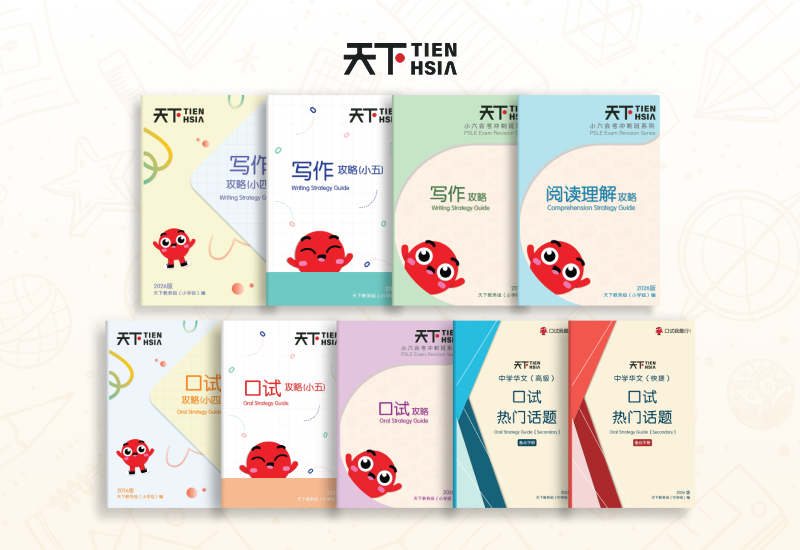
Enrolling your child in a Chinese composition writing class can also provide valuable feedback on structure, expression, and the effective use of idioms and phrases. At Tien Hsia, Primary 4 students also receive support through our 写作攻略 (Writing Strategy Guide) and 口试攻略 (Oral Strategy Guide), which help them approach both composition and oral components with clearer strategies.
4. Oral Practice and Picture Discussion
Oral exams test both fluency and the ability to respond naturally in Mandarin. While many students can describe a picture, they often find it harder to answer follow-up questions that require opinions or comparisons. Including regular oral practice in your child’s study plan helps them develop the confidence to handle these conversations more effectively.
Practical tips:
- Practise PEEL responses (Point, Example, Explanation, Link) when answering open-ended questions, so replies sound more complete.
- Encourage elaboration. If your child says, “我喜欢运动”, ask them why and which sport to deepen the response.
- Discuss current events, family outings, or news in Mandarin to expand vocabulary and make oral practice feel natural.
Structured primary Chinese tuition can also give children guided oral practice, helping them prepare for exam scenarios while building everyday confidence. At Tien Hsia Language School, our students also benefit from our Oral Exam Strategy Guide (口试攻略), a resource book that equips them with practical techniques to approach picture discussion and follow-up questions.
Turning Your Child’s Primary 4 Chinese Study Plan Into Success

Primary 4 is a pivotal year in your child’s Chinese learning journey. With a well-thought-out study plan that combines vocabulary, comprehension, composition, and oral practice, your child can approach the subject with less stress and greater confidence. The key is consistency: small daily habits at home, paired with the right external support, can make a big difference.
If you’re looking for professional, structured guidance, Chinese tuition can give your child the support they need. At Tien Hsia Language School, our teachers are trained and familiar with the Ministry of Education (MOE) curriculum, ensuring that lessons stay aligned with school requirements. We also offer an Enrichment Plus programme, a focused 3-hour programme for Primary 4 to Primary 6 students, designed to strengthen foundations and build confidence step by step.
Book a complimentary trial lesson with us and experience the Tien Hsia difference today!