


November 5, 2026
Every child’s language journey is different. Some take to Chinese naturally, while others may understand what’s being said but hesitate to speak. As a parent, you may have seen this firsthand. Your child might follow instructions in Mandarin but switch to English the moment they are asked to respond.
In the PSLE Chinese exam, listening and speaking carry significant weight alongside reading and writing. These components are designed to determine whether a child can process what they hear, organise their thoughts, and communicate clearly in real-life situations.
If your child struggles with these areas, you are not alone. Many parents in Singapore face similar concerns, especially in English-speaking households. The good news is that with the right support and environment, your child’s Chinese language skills can improve steadily over time.
Below, we explore what builds strong listening and oral fluency in Chinese, the challenges your child may face, and how they can be better equipped to excel in PSLE Chinese.
Key Takeaways
- Strong Chinese language skills, particularly in listening and speaking, are crucial for excelling at the PSLE Chinese exams.
- Many children struggle not because they lack ability, but due to limited exposure, fear of mistakes, or lack of meaningful practice opportunities.
- Consistent, low-pressure exposure at home can significantly improve their Mandarin listening skills and everyday communication.
- Encouragement, modelling, and real-life interactions can help your child build confidence in speaking Chinese.
- Structured support, such as a Chinese enrichment class, can help provide guided practice, feedback, and exam-focused preparation for PSLE success.
Why Chinese Listening and Speaking Skills Are Essential for Success
While reading and writing are often the focus of Chinese exams, true language mastery starts with the ability to understand and communicate confidently. Here’s why listening and speaking are Chinese language skills that deserve equal attention:
It Forms the Basis of Real-World Communication
Strong Chinese language skills are not just about scoring well but about helping your child function confidently in real situations. From ordering food to asking for help in class, children tend to rely more on verbal communication to navigate their environment.
When they are able to understand what is being said and respond appropriately, they become more independent and adaptable in different social settings. This also allows them to engage more meaningfully with others, whether it is speaking with teachers, interacting with peers, or communicating with family members.
Listening Supports Vocabulary Retention and Pronunciation
Listening to how the language is being spoken can help children better absorb and understand the language. Exposing your child to spoken Mandarin regularly can help them become more familiar with how words sound, how tones change meaning, and how sentences are structured. Plus, they’ll also learn from common pronunciation errors and build a more intuitive understanding of how the language flows. Over time, this repeated exposure helps them recognise and pick up vocabulary more quickly and accurately.
Speaking Builds Confidence and Deepens Understanding
Speaking the language encourages children to actively use what they have learned. When they form sentences and express ideas in Chinese, they reinforce other language skills like vocabulary, grammar, and sentence structure in more practical ways. This also makes learning more meaningful, especially when compared to passive activities like memorisation.
More importantly, regular oral practice builds confidence. As children become more comfortable expressing themselves, their fear of making mistakes decreases. Over time, this allows them to build stronger Chinese language skills and a more positive attitude towards learning the language.
Oral Fluency Encourages Active Participation in Class
Children who are comfortable speaking are also more likely to take part in classroom discussions. They tend to respond more readily to questions, share their thoughts, and clarify doubts when needed.
Moreover, oral fluency often supports a more engaged learning experience in Chinese lessons. When students are less focused on how to say something, they can pay more attention to understanding the lesson and contributing meaningfully.
It Contributes Significantly to PSLE Performance
Listening comprehension and oral components make up 35% of the total PSLE Chinese score. This means that these areas offer a strong opportunity for students to secure marks with consistent practice. Unlike written papers that may require higher-level vocabulary or composition skills, the oral and listening components focus more on clarity, understanding, and structured responses. With enough preparation, students can learn to identify key information, organise their thoughts, and respond in a way that aligns with exam expectations
It Lays the Foundation for Better Performance in Written Components
Children who are comfortable thinking in Mandarin often find it easier to write in the language.
Familiarity with sentence structures and commonly used expressions, developed through listening and speaking, can help their writing sound more natural and fluent.
Rather than translating directly from English, they begin to form ideas in Chinese from the start. This leads to clearer phrasing, more accurate grammar, and stronger overall expression. Over time, these improvements reinforce their Chinese language skills across all exam components.
What Holds Children Back From Speaking Chinese Confidently?
Even when children understand what is being said, many still hesitate to speak. Here are some common reasons why your child may struggle to build their Chinese language skills.
Limited Exposure to Spoken Chinese at Home
English is the main language spoken in nearly 50% of homes in Singapore. As a result, Mother Tongue languages like Chinese are often used mainly in school settings. Without regular exposure, a child’s Chinese language skills may weaken over time, particularly in speaking and listening. It is common for children to understand instructions or follow conversations, but feel unsure or hesitant when it comes to responding in Mandarin.
Fear of Making Mistakes
Many children worry about using the wrong words or mispronouncing tones, especially in a language where small differences can change meaning. This can make them hesitant to speak, particularly if they are concerned about being corrected in front of others. Over time, this hesitation may reduce their confidence in speaking Chinese and limit their willingness to participate.
Overemphasis on Written Exams and Memorisation
When learning focuses heavily on memorising vocabulary lists and model compositions, children may have fewer opportunities to practise speaking. While this can support written components, it does not always translate into real communication. As a result, students may recognise words on paper but find it difficult to form responses naturally during conversations or oral exams.
Negative Experiences or Feedback
A child’s past experiences can influence how they approach speaking Mandarin. Being corrected too harshly, compared to others, or laughed at can make them more self-conscious. For example, if a child mispronounces a word at home and is immediately corrected in a way that feels embarrassing, they may become more cautious about speaking up the next time. Over time, this can affect their willingness to participate and slow down their progress in building important Chinese language skills.
Lack of Engaging Practice Opportunities
Not all forms of practice feel relevant or enjoyable. Repetitive drills or scripted reading can feel disconnected from real-life communication, making it harder for children to stay engaged. Without meaningful and interactive opportunities to speak the language, they may struggle to see the purpose of practising or feel motivated to improve.
How to Strengthen Listening and Speaking Skills for PSLE Chinese
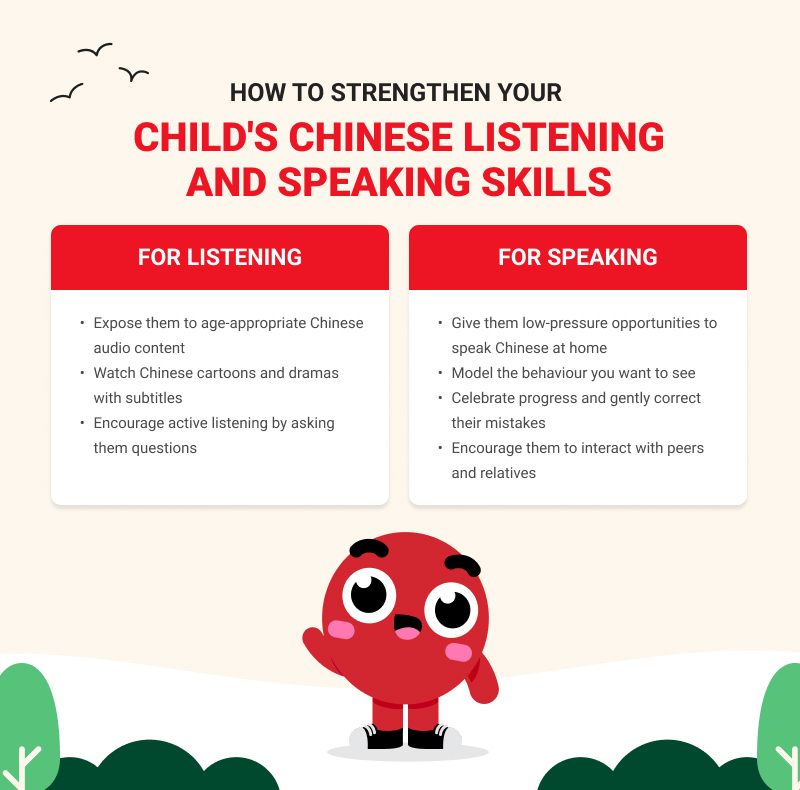
The next step is knowing how to support your child in a practical and sustainable way. Small, consistent efforts, both at home and at school, can make a meaningful difference over time. Below are some simple and effective ways to help your child strengthen their Chinese language skills and prepare for the PSLE exams.
Tips for Building Better Listening Habits at Home
Developing strong listening skills does not require intensive drilling. It starts with regular, enjoyable exposure to the language in ways that feel natural.
Use Age-Appropriate Chinese Audio Content
Choose audiobooks, nursery rhymes, or podcasts that suit your child’s interests and level. Playing these during car rides, before bedtime, or during quiet time can turn passive moments into learning opportunities. When children enjoy what they are listening to, they are more likely to stay engaged and absorb the language naturally.
Watch Chinese Cartoons or Dramas With Subtitles
Visual content helps children connect spoken words with actions and emotions. Mandarin-dubbed cartoons or shows with subtitles can reinforce both listening and pronunciation. Platforms like YouTube and Bilibili may also offer a wide range of accessible, child-friendly options to help your child build age-appropriate Chinese language skills.
Watching these shows with your child also creates opportunities for interaction. You can pause to explain unfamiliar words, repeat key phrases together, or ask simple questions about what is happening. This turns passive viewing into a more active learning experience while keeping it enjoyable and low-pressure.
Encourage Active Listening Through Q&A
After a story or video, ask simple questions to guide your child’s understanding. Questions like “What happened next?” or “Why did the character feel this way?” encourage them to listen for details and think about meaning. This approach mirrors PSLE listening comprehension tasks while keeping the experience conversational and low-pressure.
Encouraging Your Child to Speak Chinese With Confidence
Speaking can feel challenging, especially when children worry about making mistakes. Building confidence takes time, but with the right environment, children can gradually become more comfortable expressing themselves.
Create Low-Pressure Opportunities to Speak
Encourage your child to use Mandarin in simple, everyday situations rather than formal settings. This could include naming objects at home, describing their day, or ordering food at a hawker centre. For example, you might ask, “What did you do in school today?” in Chinese and let them respond at their own pace. Keep these interactions casual to reduce pressure and make speaking the language more natural. Over time, these small moments can build their confidence and make it easier for them to use their Chinese language skills in longer conversations.
Model the Behaviour You Want to See
Children learn a great deal by observing how language is used around them. Making a conscious effort to speak more Mandarin at home, even in simple phrases, helps normalise its use in daily life. It also shows that communication matters more than perfection.
Celebrate Progress, Not Perfection
Shift the focus from getting it right to simply giving it a try. When your child makes an effort to speak, acknowledge it, even if the sentence is not fully accurate. For example, if they use the wrong tone or word, you can gently model the correct version instead of pointing out the mistake directly. This keeps the interaction encouraging rather than discouraging.
Encourage Interaction With Peers or Relatives
Children often feel more comfortable speaking with people they know well. Conversations with siblings, grandparents, or even familiar hawker stall owners can create natural opportunities to use Mandarin in a relaxed setting. Over time, these small, informal exchanges help children become more confident using the language spontaneously. This, in turn, makes it easier for them to express themselves in different social situations as they grow up.
How Chinese Enrichment Classes Foster Key Language Skills
While support at home and Chinese lessons in school are important, external programmes can also provide the structure, consistency, and focused practice that children need. Chinese PSLE enrichment classes can help reinforce what is learned in school while building the full spectrum of Chinese language skills. Here’s what parents can expect from Tien Hsia’s PSLE Chinese tuition programme:
Dedicated Oral Practice in Every Lesson
Consistent exposure to oral and listening components helps students become familiar with exam formats and expectations. Through guided lessons, mock practices, and listening comprehension exercises, students learn how to identify key details, structure their responses, and communicate clearly. Regular Chinese speaking practice also helps them stay composed and confident during assessments.
Experienced Teachers Who Know How to Build Confidence
Teachers play an active role in shaping how students learn. They explain concepts clearly, model correct pronunciation, and guide students in forming accurate sentences. At the same time, they create a supportive environment where students feel comfortable participating and asking questions.
During class, our teachers also conduct regular evaluations, including spelling, practice, and mock examinations. These help track progress and highlight areas that need improvement. Parents can receive updates through teacher reports that outline their child’s strengths and areas for growth.
Interactive, Small-Group Settings
At Tien Hsia, our smaller class sizes allow students to participate more actively. Here, they are given more opportunities to speak, ask questions, and engage in discussions. Our teachers can also provide more personalised feedback, helping students improve more effectively. Through group discussions and interactive activities, students practise their Chinese language skills in a more conversational context, which helps build confidence over time.
Fun, Purposeful Activities That Make Speaking Enjoyable
Creative activities such as storytelling, role-playing, and group discussions help turn speaking into an active and enjoyable part of learning. Instead of simply repeating phrases, students learn to express ideas, respond to prompts, and engage in conversations more meaningfully.
These activities also expose students to real-life scenarios, such as describing situations, sharing opinions, or responding to questions, which closely reflect PSLE oral requirements. When learning feels purposeful and interactive, children are more willing to participate, allowing them to build confidence and improve fluency more steadily over time.
Frequently Asked Questions
1. How do I encourage my child to reply in Chinese instead of switching to English?
Consistency and modelling play an important role. If your child responds in English, try gently repeating their answer in Mandarin or continuing the conversation in Chinese to keep the flow going. Over time, this reinforces the habit without making it feel forced. The goal is to make speaking Chinese part of everyday communication.
2. Is listening more important than speaking when learning Chinese?
Listening and speaking work closely together and should be developed side by side. Active listening helps children internalise tones, sentence structures, and vocabulary, while speaking allows them to apply what they have learned. As children practise both, they build more accurate and confident communication, strengthening their Chinese language skills overall.
3. Do children need to practise Listening Comprehension and Oral regularly for PSLE Chinese?
Yes. Regular practice is important for both the Listening Comprehension and Oral exams. In Listening Comprehension, for example, students need to listen carefully, pick out key details, understand the context of the passage or conversation, and select the most accurate answer within a limited time. Without enough exposure to the format, even students who understand Mandarin may find it difficult to stay focused or identify what the question is really testing.
That is why Tien Hsia incorporates listening comprehension practices and mock exams with question formats (考试题型) closely aligned with PSLE standards. This helps students become more familiar with the pace, structure, and demands of the exam. For Oral, they also go through realistic mock exam settings and practise common themes, which helps them build confidence and respond more naturally during the actual examination.
Developing Chinese Language Skills Holistically with Tien Hsia
Fluency doesn’t happen overnight. With time, encouragement, and the right environment, your child can grow into a confident Chinese speaker and develop critical language skills. Whether it’s through casual conversations at home, listening to stories together, or joining a supportive enrichment class, every small effort adds up.
At Tien Hsia, we believe that every child is capable of expressing themselves in Mandarin, not perfectly, but proudly. When children feel safe to try, that’s when real learning begins. For students preparing for the PSLE oral exam, our in-class Oral Strategy Guide《口试攻略》offers structured techniques and practice strategies to build confidence and exam readiness. Book a free trial lesson today and experience how we make learning Chinese both meaningful and empowering.