

October 28, 2026
Introduction
As your child enters secondary school, one key decision is whether to take Higher Chinese. If your child has consistently done well in Chinese or enjoys using the language, the choice can be relatively straightforward. But if your child has mixed strengths, such as being confident in speaking but weaker in writing or comprehension, the decision may be less clear.
Higher Chinese is not simply a more difficult version of G3 Chinese. It expects students to read more carefully, write more clearly, and express their ideas with greater confidence. While it can be a good fit for students with a strong foundation, it also requires consistent effort and additional support.
In this guide, we will look at what the subject involves, its benefits, and the key factors to consider when deciding if it suits your child.
Key Takeaways
- Higher Chinese is an advanced subject that sits above G3 Chinese and is designed for students with a strong language foundation and a readiness to handle more demanding tasks.
- Parents should look beyond overall Chinese grades when deciding whether the subject is suitable.
- A child’s interest in the language, strengths across different components, emotional resilience, and wider secondary school workload are equally important.
- Students can benefit from regular exposure to Chinese at home, vocabulary building in context, and constructive encouragement.
- Where needed, Chinese enrichment classes at Tien Hsia can also help them strengthen composition, comprehension, oral communication, and exam skills.
What is Higher Chinese?
In Singapore, the Ministry of Education (MOE) offers Mother Tongue Languages at different subject levels so that students can learn at a pace and level that better matches their readiness.
Under Full Subject-Based Banding, Chinese Language may be offered to secondary one students at the following levels:
- G1: Provides more foundational support and focuses on building basic language skills.
- G2: Builds towards a broader level of language competence with moderate learning demands.
- G3: An academically demanding standard Chinese option at the secondary school level, requiring stronger language proficiency.
- Higher Chinese: Offered to selected students with a stronger foundation and aptitude in the language.
A student’s starting subject level is generally based on their PSLE performance, though schools may also allow selected students to take certain subjects at a more demanding level. From 2026, MOE has widened access to Higher Mother Tongue at the secondary level. Students who score AL1 or AL2 in Mother Tongue at the PSLE, or obtain a Distinction or Merit in Higher Mother Tongue, can offer Higher Mother Tongue in Secondary 1 regardless of their overall PSLE score.
What Will Your Child Learn in Higher Chinese?
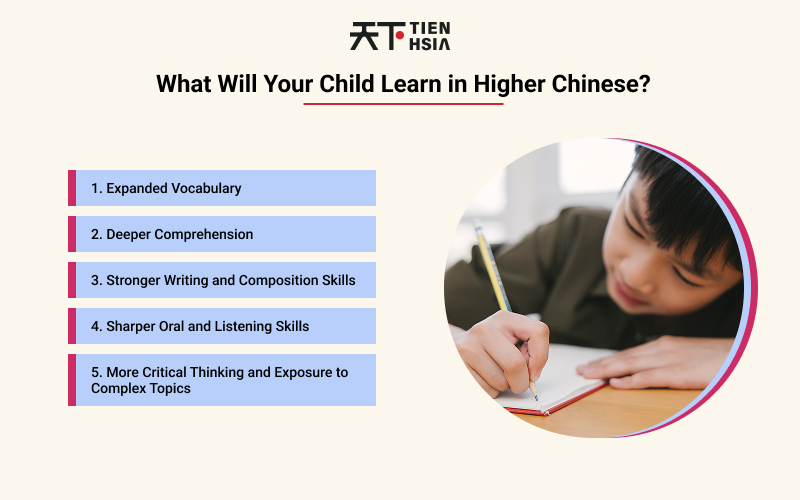
Expanded Vocabulary
Higher Chinese exposes students to a richer range of vocabulary, more formal expressions, idioms (成语), and varied sentence structures that go beyond everyday conversation. For example, instead of simple phrases like “很开心” (very happy), students may encounter more precise expressions such as “喜出望外” or “心情愉悦” and be expected to understand them in context.
Deeper Comprehension
In comprehension sections, such as the open-ended questions in Paper 2, students need to go beyond surface meaning. They are expected to know how to infer tone, unpack implications, and respond with accurate phrasing lifted or adapted from the text. For instance, a passage might not directly state that a character is disappointed, but students must infer it from actions or dialogue. For children who are used to relying on direct clues, this shift towards inference and precision can be a noticeable jump in difficulty.
Stronger Writing and Composition Skills
Composition is a major component of Higher Chinese. Students are expected to write with better structure, stronger vocabulary, and more thoughtful content development. They are expected to organise their ideas clearly (introduction, development, conclusion), use appropriate connectors (如“首先”、“其次”、“因此”), and include relevant details or reflections.
Instead of producing a straightforward story, students are encouraged to develop richer plots, describe emotions more precisely, and include reflections or lessons learnt. For instance, rather than simply writing “我帮助了同学” (I helped a fellow student), a stronger response might explain why the help was meaningful and what the student learnt from the experience.
Sharper Oral and Listening Skills
Higher Chinese also places stronger demands on verbal communication and listening comprehension. In the exam, a video-based oral presentation is followed by a discussion. Students need to describe what they see, express their opinions, and support their answers with reasons or personal experiences. For example, they might be asked whether they agree with a character’s actions and explain why.
Listening comprehension tasks also require stronger focus and contextual understanding. Students may need to follow longer audio passages, identify key details, and understand implied meaning rather than just pick out keywords.
More Critical Thinking and Exposure to Complex Topics
A key feature of the MOE Higher Chinese curriculum is that it asks students to think more deeply in the language.
Rather than only recalling information, students are often expected to compare viewpoints, explain causes and effects, form opinions, and support their responses with examples. In comprehension or oral tasks, they may be asked questions like “你是否同意这种做法? 为什么?” (Do you agree with what he did? Explain why) or “这件事带来了什么影响?” (What impact did this incident have?)
Students may need to discuss everyday issues, social trends, or values-based scenarios in Chinese, such as the impact of social media, helping others in the community, or making responsible choices.
Should Your Child Take Higher Chinese in Secondary School?
While the subject offers clear benefits for some students, it is not automatically the best option for every child who scores well in Chinese. Here’s what you and your child should consider.
1. Your Child’s Interest in the Language
A child who genuinely enjoys reading Chinese storybooks, watching Mandarin content, or discussing ideas in Chinese is often better equipped to cope well with the Higher Chinese syllabus. Interest does not guarantee strong results, but it does make the subject more sustainable. When students are curious about the language, they are usually more willing to revise vocabulary, practise oral responses, and push through difficult passages.
On the other hand, if your child already finds Chinese lessons draining and sees the language purely as an exam hurdle, a more advanced level of study may feel like a constant uphill battle and affect their self-confidence.
2. Past Performance and Learning Patterns
A child who consistently does well in G3 Chinese may have the academic foundation for Higher Chinese, but parents should look beyond the overall grade. How does your child perform across the different components? Are they strong in comprehension but weak in composition? Do they speak well but lose marks in closed-ended language questions? Can they read longer passages without giving up halfway?
Higher Chinese tends to expose gaps more quickly, especially in vocabulary range, written expression, and stamina with tougher texts. If your child’s strong grades come mainly from oral or memorised formats, they may still need structured preparation before taking on a comprehensive curriculum.
3. Feedback From Teachers and Tutors
If you are on the fence, speak to the adults who teach your child Chinese. Teachers at your child’s school and tutors from your child’s Chinese tuition classes can give a more realistic perspective. They can comment on things parents may not see at home, such as how quickly the child processes reading passages, whether they can respond thoughtfully during oral discussions, and how independent they are during writing tasks.
4. Overall Academic Workload
Even if your child is capable of doing well at a more advanced level, it’s still important to consider their workload.
Secondary school can become heavy very quickly. Some students are balancing Higher Chinese with Additional Mathematics, pure sciences, demanding CCAs, leadership roles, and the adjustment to a faster academic pace. In these situations, the question is whether they can manage Higher Chinese well without burning out.
Parents know their child best here. Some students are energised by challenges and enjoy having a fuller timetable, while others need more breathing room. It’s important to have a conversation with your child to better understand their needs, capabilities, and willingness to take on an extra workload.
How to Support Your Child’s Journey in Higher Chinese
If your child has decided to take Higher Chinese, the next question is often how you can support them without turning the subject into another source of stress at home.
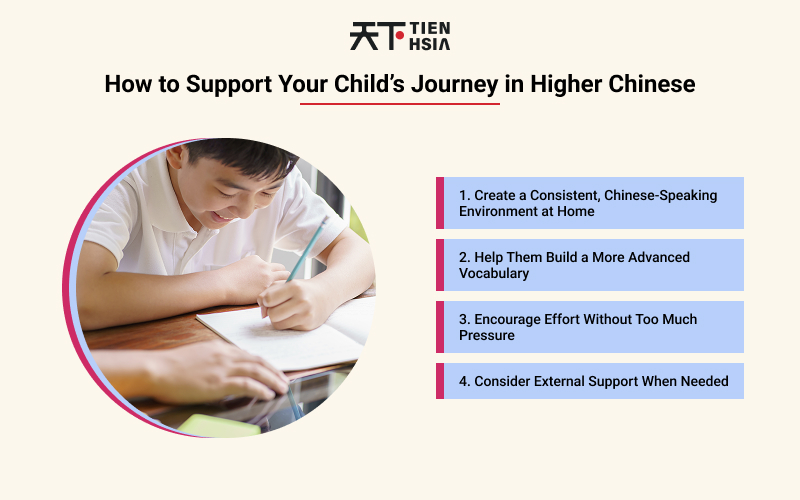
Create a Consistent, Chinese-Speaking Environment at Home
As your child goes into secondary school, they will need to start handling more complex tasks and ideas. Regular exposure to Chinese outside of school and homework becomes even more important here.
Encourage them to build simple, age-appropriate habits, such as:
- Reading short Chinese news articles or youth magazines
- Watching Mandarin dramas or variety shows with subtitles
- Following Chinese-speaking content creators they enjoy
You can also have short conversations in Mandarin about their school day, current events, or topics they are interested in. These small, consistent exposures can help them become more comfortable with sentence structures, vocabulary, and natural expression over time.
Help Them Build a More Advanced Vocabulary
At this stage, students are expected to use more precise and varied vocabulary, especially in composition and comprehension.
Rather than relying only on memorising word lists, encourage your child to keep a vocabulary notebook organised by themes such as school life, technology, or social issues. Ask them to include example sentences and note how certain phrases are used in context. When they come across useful expressions in passages or model essays, prompt them to think about when they could use these phrases in their own writing. This helps them move beyond memorisation and towards applying vocabulary effectively.
Encourage Effort Without Too Much Pressure
At this age, students are becoming more aware of their academic performance, and too much pressure can quickly undermine their confidence.
Try to recognise effort and improvement, not just results. For example, if your child uses a more varied vocabulary, gives clearer answers during oral practice, or shows a better understanding in comprehension, acknowledge these gains. This helps them see Higher Chinese as a subject they can steadily improve at rather than something they either succeed or fail in.
Consider External Support When Needed
Some students cope well with school support alone. Others may benefit from additional guidance, especially if they are starting to lose confidence, struggle with composition and comprehension, or find it hard to keep up with the pace of lessons.
This is where Higher Chinese tuition can be useful. A well-structured programme should help students break down difficult texts, strengthen essay planning, practise oral responses with targeted feedback, and develop a clearer approach to exam questions. Just as importantly, the right support can help students feel less overwhelmed and prevent small gaps in understanding from turning into long-term frustration.
Tien Hsia’s Approach to Preparing Students for Higher Chinese
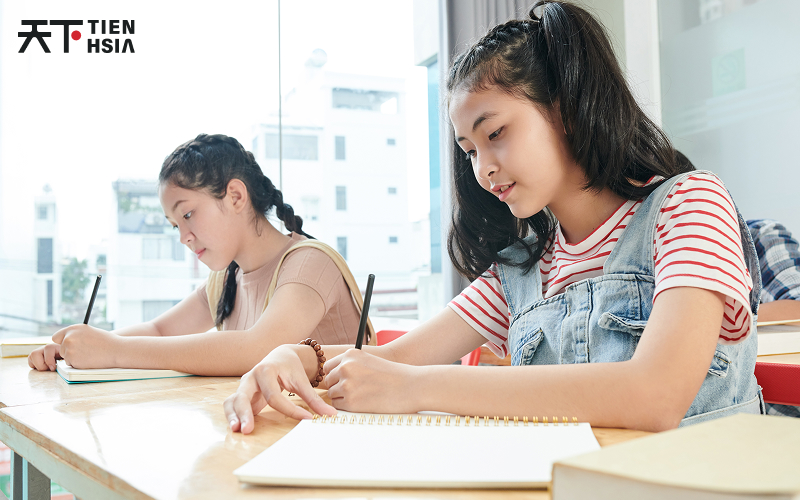
At Tien Hsia, our Higher Chinese tuition programmes for secondary students are designed to build the language depth and exam readiness needed for Higher Chinese, not just to keep up with schoolwork. We complement the MOE school syllabus with structured weekly lessons that strengthen comprehension, writing, oral communication, and vocabulary development in a more focused way.
Weekly Lessons That Go Beyond Worksheets
Each weekly lesson gives students time to work meaningfully with the language. Alongside curriculum-based learning, at least 30 minutes are set aside for guided discussions using multimedia resources, current affairs, newspaper articles, or literary texts. These conversations encourage students to think critically, form opinions, and express themselves in Chinese, which supports both oral communication and higher-level composition work.
Our Sec 4 Chinese tuition programmes also place greater emphasis on targeted O-Level preparation. Students receive more focused exposure to exam-style questions, timed practice, revision of common question types, and guidance on applying their language skills accurately under examination conditions.
Alternating Practice in Composition & Comprehension
We practise composition and comprehension on alternate weeks, allowing students to develop both skills consistently rather than focusing on only one area at a time. Our teachers guide students through essay planning, language use, close reading, and answer development, helping them write with clearer structure and respond more precisely to demanding passages. This also gives students time to strengthen key skills before school assessments and examinations.
Vocabulary, Revision, and Exam Skills Built Into the Programme
We introduce students to new vocabulary through guided lessons, followed by vocabulary tests to reinforce retention and application. Regular tests, revision exercises, and mock examinations help students become familiar with exam formats, identify areas that need more attention, and prepare in advance for school examinations. Our teachers also conduct dedicated lessons for oral and listening comprehension, where they share practical strategies to help students organise their responses and communicate their ideas more eloquently.
For further support, Tien Hsia has expanded its Oral Strategy Guide, 《口试攻略》, to include upper secondary Higher Chinese requirements. This gives students practical tools to approach one of the more demanding components with clearer structure, stronger ideas, and greater confidence.
Frequently Asked Questions
1. My child does well in Chinese but dislikes composition. Should they still take Higher Chinese?
Possibly, but it depends on why they dislike it. If the issue is weak planning, limited vocabulary, or low confidence, those are areas that can improve with guidance and practice. The key is to identify whether the composition is a temporary weakness or a sign that the subject may become a source of constant stress.
2. How can I tell if my child is coping well with Higher Chinese?
Look at both academic and emotional signs. On the academic side, check whether your child is reasonably steady across composition, comprehension, oral, and listening. On the emotional side, notice whether they still engage with the subject, recover from setbacks, and approach lessons without dread every week. Feedback from teachers can also help you see whether your child is coping, plateauing, or starting to struggle in ways that need intervention.
Conclusion
Choosing Higher Chinese is not only about whether your child qualifies for it. It should also suit their language foundation, interest in Chinese, learning habits, confidence, and ability to manage a more demanding workload. For the right student, it can be a meaningful way to deepen bilingual skills and develop greater confidence in using Chinese.
If you are considering Higher Chinese classes for your child, give them a strong head start with Tien Hsia’s proven approach to comprehension, writing, oral communication, and exam preparation. Book a complimentary trial class today and let your child experience engaging lessons, expert guidance, and the confidence they need to excel in their next stage of learning.